— Answers, in plain language
Frequently Asked Questions
Straight answers to the questions we hear most — across estate planning, business asset protection, compliant entity formation, and registered agent services.
Estate Planning
6 questions
Business Asset Protection
6 questions
Compliant Entity Formation
6 questions
Registered Agent Services
6 questions
Estate Planning
Planning for what happens next
A good estate plan decides who receives what, who makes decisions if you can’t, and how to spare your family the cost and delay of probate — all on your terms.
What’s the difference between a will and a trust?
plus
A will directs who receives your assets after you die, names guardians for minor children, and takes effect only at death — after going through probate, the court-supervised process of settling your estate.
A revocable living trust holds your assets during your lifetime and passes them to your beneficiaries privately, usually without probate. It can also manage your affairs if you become incapacitated. Most complete plans use both: a trust as the centerpiece and a “pour-over” will as a backstop.
Do I really need an estate plan if I’m not wealthy?
plus
Yes. Estate planning isn’t about the size of your estate — it’s about control. If you have minor children, own a home, run a business, or simply want to choose who inherits and who makes medical and financial decisions for you, you need a plan.
Without one, the state’s default rules decide all of that for you, and your family navigates it through the courts during an already difficult time.
What happens if I die without an estate plan?
plus
You die “intestate", and your state’s intestacy statutes decide who inherits — a fixed formula that may not match your wishes. A court appoints an administrator, may appoint guardians for your children without your input, and the whole estate typically passes through probate: public, slower, and more expensive than a well-built plan.
What documents are in a basic estate plan?
plus
A core plan usually includes four pieces: a revocable living trust to hold and distribute assets, a last will and testament (often a pour-over will), a durable power of attorney so someone you trust can handle finances if you can’t, and an advance healthcare directive / living will for medical decisions.
Depending on your situation, it may also include beneficiary designations , a HIPAA authorization, and entity or asset-protection planning.
Does a living trust avoid probate?
plus
It can — but only for the assets actually titled in the name of the trust. Creating the trust document is half the job; funding it (retitling your home, accounts, and other assets into the trust) is what keeps them out of probate. An unfunded trust is one of the most common planning mistakes, which is why we walk clients through funding rather than just handing over documents.
How often should I update my estate plan?
plus
Review it every few years and after any major life event — marriage or divorce, a birth or death in the family, a significant change in assets, a move to another state, or starting or selling a business. Laws change too, so a plan that was airtight a decade ago may no longer do what you intend.
arrow_up
Back to top
Business Asset Protection
Keeping one claim from reaching everything
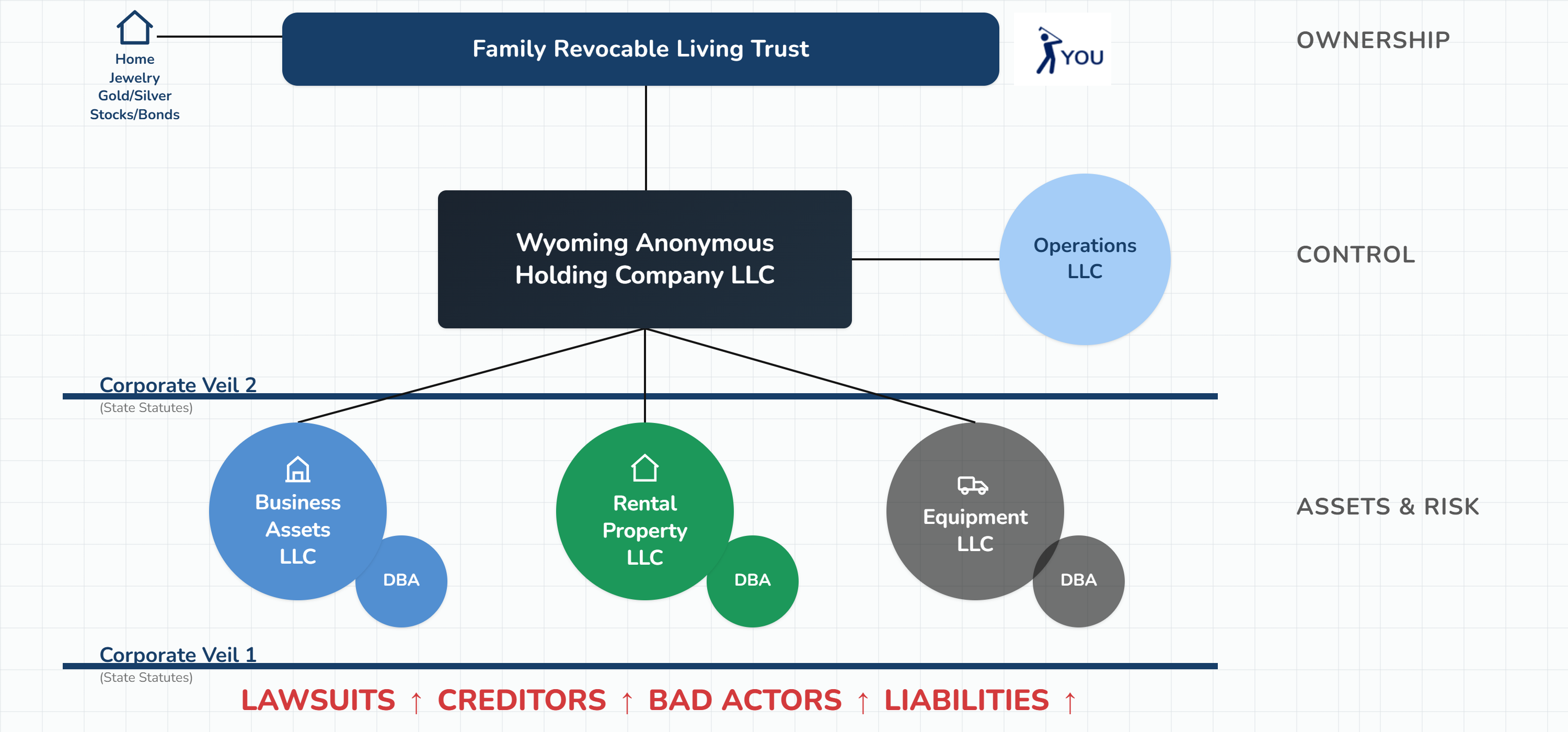
Asset protection is about structure — legally separating what generates risk from what holds value, so a single lawsuit can’t cascade across everything you own.
What is asset protection, exactly?
plus
It’s the practice of arranging how you own things so that an unexpected claim — a tenant injury, a contract dispute, a partner’s personal creditor — can only reach the assets directly tied to that risk, not your whole net worth. It’s not about hiding assets; it’s about building legal separation in advance.
Isn’t my LLC already enough protection?
plus
An LLC protects your personal assets from the business’s liabilities — that’s its core job. But it does the reverse poorly: if every property and asset sits inside one LLC, a single lawsuit puts all of it on the table. Real protection adds layers around and between your entities, rather than relying on one LLC to do everything.
What is charging-order protection?
plus
If a creditor wins a judgment against you personally, they may come after your ownership interest in your companies. In states with strong charging-order protection, their only remedy is a “charging order” — they can receive distributions if and when the company makes them, but can’t force a sale, take over management, or seize the assets inside. The strength of that protection varies significantly by state, which is why jurisdiction matters.
When should I set up asset protection?
plus
Before there’s a claim on the horizon. Once a lawsuit exists or is reasonably foreseeable, moving assets to shield them can be unwound as a fraudulent transfer — sometimes with penalties. Protection built during calm times, for legitimate business reasons, is the kind courts respect.
Can asset protection shield me from my own actions?
plus
No. No structure protects you from your own personal negligence, fraud, or misconduct, from debts you personally guaranteed, or from certain tax obligations. What it does is contain ordinary business and ownership risk so a single event can’t reach everything you own.
Will setting this up affect my taxes?
plus
Often not. Many protective structures are tax-neutral — pass-through entities and holding companies that don’t change what you owe. We don’t prepare taxes, but we coordinate with your CPA so the structure fits your tax picture rather than fighting it. For a deeper walk-through, see our business asset protection page.
arrow_up
Back to top
Compliant Entity Formation
Forming it right the first time
An entity only protects you if it’s formed in the right state, documented correctly, and kept in good standing. The filing is the easy part — the compliance is what makes it hold.
Which state should I form my LLC in?
plus
It depends on what the entity will do. If it operates or holds real estate in one state, that state is usually the right home. States like Wyoming are popular for holding companies because of strong charging-order protection and privacy, but forming out of state while operating elsewhere can trigger foreign-qualification requirements and extra fees. The “best” state is the one that fits your facts — not a one-size-fits-all answer from a video.
LLC, corporation, or S-corp — what’s the difference?
plus
An LLC is flexible, simple to maintain, and offers liability protection with pass-through taxation by default. A corporation (C-corp) is a more rigid structure often used when raising outside investment. S-corp isn’t a separate entity at all — it’s a tax election an LLC or corporation can make, sometimes to reduce self-employment tax. The right choice turns on your goals, income, and how you’ll take money out; it’s worth deciding with an attorney and CPA together.
Do I need an operating agreement?
plus
Yes — even for a single-member LLC. The operating agreement is what proves your LLC is a real, separate entity rather than an extension of you, and it’s central to keeping your liability protection intact. It sets out ownership, management, how money moves, and what happens if an owner leaves. A missing or generic agreement is one of the first things a creditor’s attorney looks for.
When do I have to register in another state?
plus
When you’re “transacting business” in a state other than where you formed — for example, owning rental property, having employees, or maintaining an office there. That requires foreign qualification: registering your existing entity in the new state. Skipping it can mean penalties, back fees, and even losing your right to sue in that state’s courts.
What ongoing compliance does my entity need?
plus
Forming the entity is the start, not the finish. Most entities need to file annual or biennial reports, pay state fees, maintain a registered agent, keep business and personal finances strictly separate, and observe basic formalities. Letting these lapse can administratively dissolve your entity — and a dissolved or neglected entity is far easier for a court to pierce.
Can’t I just form it myself online?
plus
You can file the paperwork yourself, and for the simplest situations that may be fine. But the filing is the commodity part; the value is in choosing the right state and structure, drafting an operating agreement that actually protects you, handling foreign qualification, and keeping it compliant. A confidently wrong setup often isn’t discovered until it’s tested in court — which is the worst time to find out.
arrow_up
Back to top
Registered Agent Services
A reliable address for what matters
Every entity needs a registered agent in each state where it’s registered — the official point of contact for legal notices and state mail. Done right, it also keeps your home address off the public record.
What is a registered agent?
plus
A registered agent is the person or company designated to receive official documents on your entity’s behalf — legal service of process (lawsuit papers), state notices, and compliance reminders. Every state requires one for each registered entity, with a physical street address in that state and availability during business hours.
Why not just be my own registered agent?
plus
You usually can, but there are real downsides. Your name and address go on the public record, you have to be physically present during business hours to accept service, and being handed a lawsuit at your home or in front of customers is not ideal. A professional agent gives you reliability, privacy, and a buffer so nothing critical slips through.
What does a registered agent actually do?
plus
They maintain a valid address in the state, accept legal and government documents on your behalf, and promptly forward them to you — often with deadline tracking so a lawsuit or state notice never goes unanswered. Many also help keep your entity in good standing by flagging upcoming annual-report and renewal deadlines.
What happens if I don’t have one — or it lapses?
plus
It’s serious. Without a valid registered agent, the state can administratively dissolve your entity, and you can be sued without ever receiving notice — leading to a default judgment entered against you simply because no one received the papers. Keeping a reliable agent is a small cost that prevents large problems.
Do I need a registered agent in every state I operate in?
plus
Yes. You need one in your formation state and in every state where you’ve foreign-qualified. If you own property or do business across several states, you’ll need an agent in each — which is why many multi-state investors prefer a single provider that can cover all of them.
Does a registered agent make me “anonymous”?
plus
It helps keep your personal address off public filings, which lowers your profile — but it isn’t a shield by itself. Anonymity is often oversold: a charging order and a subpoena don’t care whose name was on the paperwork. Privacy is one useful layer of a real protection plan, not a substitute for proper structure.
arrow_up
Back to top
Still have questions?
The best answers depend on your specific situation. Book a consultation and we’ll walk through yours together — no obligation.
This page is for general educational purposes and does not constitute legal, tax, or financial advice or create an attorney-client relationship. Laws vary by state and change over time, and outcomes depend on your specific facts. Speak with a licensed attorney about your individual situation before acting.